Alberta votes about three to one to stay in Canada, but the nine other questions on its ballot are much closer
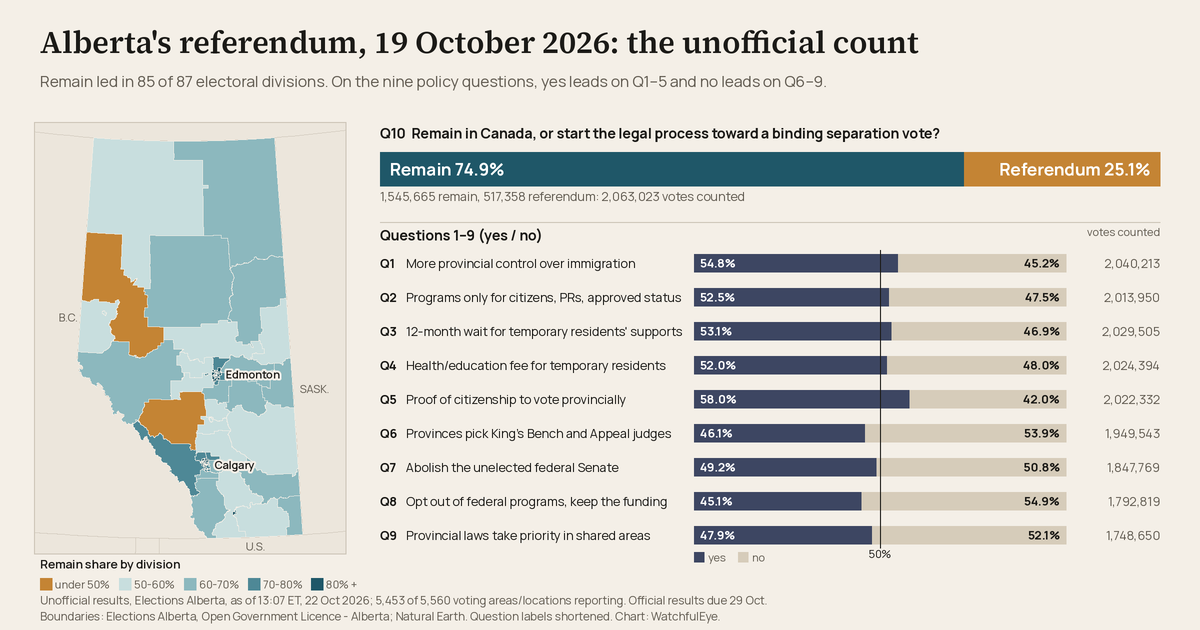
Voters in Alberta, Canada's oil-rich western province, rejected a move toward independence in a referendum on Monday 19 October. With 2,063,023 votes counted on that question by 13:07 ET on Thursday 22 October, 74.9% chose to remain in Canada and 25.1% wanted the province to start the legal process toward a binding vote on leaving, according to unofficial results from Elections Alberta. Premier Danielle Smith said the result gave her government "a clear mandate" and that she would not hold another referendum on the issue while she is premier. The count is unofficial until 29 October, when Elections Alberta says it will publish official results.
What happened
- The question: voters were asked whether Alberta should remain a province of Canada, or whether the provincial government should begin the legal process under the Canadian Constitution to hold a binding referendum on separation. In effect, it was a vote on whether to hold a second vote. It was the first Canadian independence referendum held outside Quebec, DW noted.
- Turnout: 1,356,873 votes were cast before election day: 837,791 at advance polls and 519,082 by special ballot. Elections Alberta put that early turnout at 43.1%.
- Premier Danielle Smith, who called the vote in May and said she voted to stay, gave a televised address on Tuesday evening. "Alberta will remain a province of Canada," she said, according to the text published by the Alberta government. "For as long as I am Premier, I will honour this mandate from Albertans and will not be holding another referendum on this issue." She said disputes with Ottawa "will be settled within the political and legal institutions of our nation rather than pursuing the option of separation."
- Prime Minister Mark Carney said Albertans had made a "clear choice" for unity, AFP reported. On Tuesday he added that "constitutional change is difficult. It's long," and said he favoured "common solutions" with the provinces, The Canadian Press reported.
- The separatists said they would keep going. "We're not going anywhere," said Jeff Rath of the Alberta Prosperity Project, the main group pushing for independence, according to The Canadian Press.
The American angle
The campaign drew open interest from the Trump administration and its allies. On 22 January, at the World Economic Forum in Davos, US Treasury Secretary Scott Bessent told the right-wing commentator Jack Posobiec that Alberta was "a natural partner for the US", the BBC reported. Leaders of the Alberta Prosperity Project said they had met State Department officials in Washington three times and discussed issues such as currency and border security, NBC News reported in February. A senior State Department official told NBC the department "regularly meets with civil society types", that only staff-level meetings had taken place, and that no commitments were made. In July, the US ambassador to Canada, Pete Hoekstra, said the vote was "a decision for the people of Alberta" and that he had "clear direction from Washington" not to try to influence it, the National Post reported. This month, Elon Musk posted on X that Alberta "should separate," AFP reported.
There was no immediate reaction to the result from President Donald Trump, Reuters reported, via CNBC, on 20 October. The vote came during a US trade war with Canada and repeated talk from Trump of making Canada a US state. Carney, who grew up in Alberta, has worked with Smith on a new oil pipeline to the Pacific coast, the kind of pipeline Bessent complained in January that Alberta was not being allowed to build.
Why it matters
WatchfulEye's read: the separation result is the headline, but it was the question with the least immediate legal effect. Even a "yes" would only have started a process toward a second, binding referendum. The nine other questions on the same ballot are the ones aimed at changing policy now. Five ask whether Alberta should take more control over immigration, limit or charge for some newcomers' access to health care, education and other provincial programs, and require proof of citizenship to vote. Four ask whether it should seek constitutional changes with other provinces, including abolishing the Senate. Smith said she needed a "yes" on those nine to get a mandate to bargain with Carney; Carney urged Albertans to reject them, The Canadian Press reported.
The unofficial count splits those nine down the middle of that list. By 13:07 ET on 22 October, "yes" led on all five immigration and voting questions, from 58.0% on proof of citizenship to vote down to 52.0% on charging temporary residents for health care and education. "No" led on all four constitutional questions, from 54.9% on letting provinces opt out of federal programs without losing the funding down to 50.8% on abolishing the Senate, where the gap was 30,741 votes. On Tuesday night, with fewer ballots counted, "yes" had led on all but one of the nine.
That makes this a result with three parts. A clear "no" to separation strengthens Carney's hand on national unity while the trade war continues. On immigration, Smith now has majorities to point to: in her address she said Albertans appeared to have directed her government "to take greater control over immigration," and on Wednesday she suggested she could bring in legislation in spring 2027 on questions that pass, Radio-Canada reported. Asked whether Alberta could get a Quebec-style immigration deal, Carney replied "We'll see," in French, The Canadian Press reported, via Global News. On the Constitution, the count so far gives Carney grounds to say Albertans did not ask for that fight. Smith's own position is not settled either: two of her party's local associations have reportedly backed calls for an early leadership review, and the next provincial election is due in October 2027, The Canadian Press reported.
What is confirmed, and what is not
- On the record: Elections Alberta's unofficial count and its 29 October date for official results; the CBC and CTV projections on separation, reported by AFP; Smith's address; statements by Carney and Rath; Bessent's remarks; the State Department's description of the meetings; Hoekstra's statement.
- Not final: every figure here is unofficial. At 13:07 ET on 22 October, 107 of 5,560 voting areas and locations had not reported, and the Senate question, the closest, was separated by less than two percentage points. Leads on the nine questions have already changed as the count went on. Elections Alberta had said it would finish counting within 48 hours of polls closing; early on 22 October it said counting was continuing and it was "not estimating a time for completion," CBC News reported.
- Not established: which US officials the separatists met. Both the group and the administration declined to name them, NBC reported. We found no on-record White House, State Department or Treasury comment on the result by the afternoon of 22 October.
Open questions
- Do the leads on the nine questions hold in the official results on 29 October, especially the Senate question?
- What legislation does Smith bring forward on immigration, and does she face a leadership review at her party's meeting next month?
- Does the Trump administration comment on the result, after Bessent's earlier remarks?
- Does the result change the pace of the Pacific pipeline project or US-Canada trade talks?