Riyadh airport attack kills 13 and injures more than 300; the Houthis claim responsibility
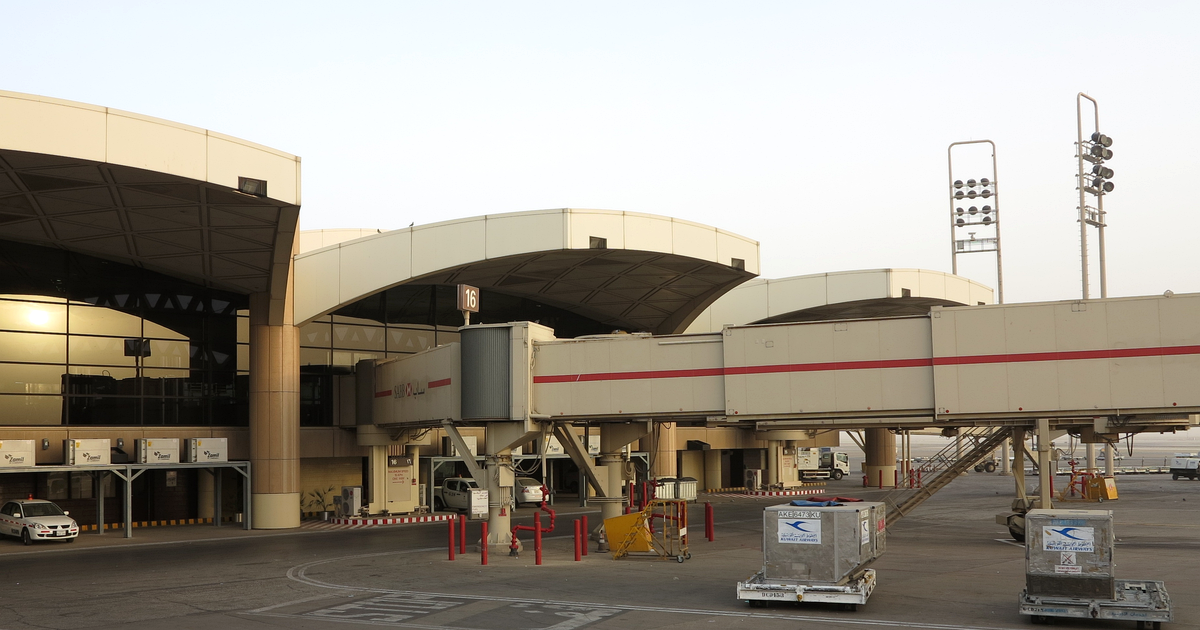
Archival photograph, not an image of the attack: King Khalid International Airport's Terminal 1 seen from the apron, Riyadh, 7 March 2013. Photograph: Kayhan Ertugrul / Wikimedia Commons, CC BY-SA 3.0. Cropped.

Update, 15 October: The Saudi-led coalition said on Thursday that it had intercepted a cruise missile over the Medina region, according to coalition spokesman Turki al-Maliki, CNN Arabic reported. The Houthis denied carrying out any attack on Saudi Arabia that day. "The Yemeni armed forces confirm that they did not carry out any targeting operation today towards Saudi territory," Houthi military spokesman Yahya Saree said on X, and he called the Saudi account of a strike towards Medina "a great slander", CNN Arabic reported (WatchfulEye's translation from Arabic). Middle East Eye also reported the coalition's account and the Houthi denial.
WatchfulEye's read. When the Houthis warned international airlines on 12 October that Saudi airports were unsafe, they excluded the airports in Mecca and Medina, AP reported (see the 12 October (evening) update on this page). A missile fired towards Medina would sit outside that stated exclusion, which is why both the coalition's claim and the Houthi denial matter.
What we don't know. Who fired the missile, from where, and what it was aimed at. Neither the coalition's account nor the Houthi denial had been independently confirmed in the reports available on Thursday.
Update, 14 October: The Houthis said on Wednesday that they had fired ballistic missiles, cruise missiles and drones at Saudi Aramco facilities in Dhahran, at Riyadh's airport and at an Aramco refinery in Riyadh, and urged "international shipping companies", civilians and workers to evacuate Saudi airports and oil facilities, Reuters reported. Saudi authorities have not confirmed a new strike on the airport or the refinery, DW reported. The Saudi-led coalition said it intercepted a ballistic missile fired towards Riyadh on Wednesday. On Tuesday's strike in Dhahran, three people with direct knowledge of the matter told Reuters that Aramco's headquarters suffered extensive damage, with a fire spreading between the sixth and 10th floors of an office block; another said the top three floors, where chief executive Amin Nasser's office is, were severely damaged. The energy ministry has described "a limited fire". Two of the people said operations at the complex continued normally, with some employees asked to work from home. Aramco did not reply to Reuters' request for comment.
Update, 13 October (late): Later on Tuesday night, an official source at Saudi Arabia's Ministry of Energy said an administrative building belonging to Saudi Aramco in Dhahran had been targeted, causing "a limited fire" with no injuries or deaths, the Saudi Gazette reported. This supersedes the earlier note in the 13 October update that the reports then available described no damage to Aramco facilities. A company source told Reuters that a ballistic missile hit an office tower in Aramco's Dhahran headquarters complex and damaged its top three floors; the coalition said it had intercepted a missile over Dhahran and that fragments fell in a residential area. Neither official account says whether the building was hit directly or by debris, and no report describes any effect on Aramco's oil operations. Saudi Civil Defense said four people were injured in Riyadh by fragments of two intercepted missiles, Reuters reported.
Update, 13 October: The Saudi-led coalition struck the Houthi-run Yemen Petroleum Company's al-Sabaha fuel facility near Sanaa on Tuesday after warning civilians to leave the area, coalition spokesman Maj Gen Turki al-Maliki said, the BBC reported. Al Jazeera's correspondent in Sanaa also reported strikes on oil storage tanks at Ras Isa port and on an oil station in Hodeidah province; the coalition has not confirmed those. Before the strike, Houthi military spokesman Yahya Saree warned that any attack on Sanaa would bring a "harsh and painful" reprisal on Riyadh and told civilians to leave Aramco's headquarters in Dhahran, King Khalid International Airport and an Aramco refinery in Riyadh, calling Saudi oil facilities "a legitimate target," Al Jazeera reported. After the strike, al-Maliki said four missiles and two drones were intercepted near Riyadh, missiles aimed at cities including Dammam were also intercepted, and shrapnel fell in a residential area in Dhahran, the BBC reported. None of these reports describe damage to Aramco facilities. AFP reported queues at Sanaa petrol stations after the coalition's warning; the Houthi-run fuel company said the facility held no stock of petroleum products. The Saudi cabinet, chaired by Crown Prince Mohammed bin Salman, said the Houthis would "bear the consequences" of their attacks on the kingdom. President Donald Trump said the Houthis were "purposefully trying to drive up Oil Prices, probably prior to the US Elections," adding "I will never forget," Al Jazeera reported, citing his Truth Social post. He announced no US military action.
Correction, 14 October: An earlier version of this update said the Houthis told civilians to leave Aramco's headquarters in Dammam. Aramco's headquarters is in Dhahran, as Al Jazeera's updated report states.
Update, 12 October (late): President Donald Trump criticised the Houthis after the renewed attacks on Saudi airports but gave no decision on US military involvement, saying "the Houthis are misbehaving very badly. No good," Al Jazeera reported, citing his comments to reporters. Speaking at an energy conference in Riyadh, Saudi Energy Minister Prince Abdulaziz bin Salman said the airport attacks had tested the kingdom's resilience: "The events of recent weeks are serious. Our response must be equally serious," and that Vision 2030 "must continue," Al Jazeera reported. Etihad Airways cancelled flights to Riyadh and also suspended flights to Dammam and Jeddah, and Gulf Air cancelled Riyadh flights through Saturday, Al Jazeera reported. Monday's coalition interception claims and the Houthi airline warning are already on the earlier evening update.
Update, 12 October (evening): Saudi Arabia has opened an investigation into how its air defences failed to stop the drones and missiles that hit King Khalid International Airport, two regional officials told the Associated Press on condition of anonymity. An initial review found that the Houthis first launched several drones to clear a path for a mix of cruise and ballistic missiles, which flew more than 1,000 kilometres to reach Riyadh, the officials said; the inquiry is also examining why there was no earlier warning. The Saudi government's media office did not immediately respond to a request for comment, AP reported. On Monday, the Saudi-led coalition said it intercepted and destroyed ballistic missiles fired by the Houthis toward Riyadh, and the Houthis said they had again targeted the airport and warned international airlines that all Saudi airports except those in Mecca and Medina were unsafe, AP reported. The Houthis also claimed a strike on an air base in Khamis Mushait in the southwest, ABC News reported. The airport will remain closed until at least 21:00 GMT on 17 October, Anadolu Agency reported, citing Flightradar24. Saudi Arabia has not said publicly what the investigation has found.
Update, 12 October (afternoon): Delta Air Lines will delay the launch of its nonstop service between Atlanta and Riyadh, planned for 23 October, until March, CNBC reported; it would have been the first nonstop commercial flight between the US and Saudi Arabia operated by a US airline. The decision followed a notice from the US Federal Aviation Administration on Sunday telling US airlines to exercise caution when flying to or over Saudi Arabia, citing ongoing military activities and navigation-system interference. "Threats could pose a potential risk to aircraft at all altitudes, including overflight, the arrival, and departure phases of flight," the FAA said, Reuters (via Al-Monitor) reported. The notice lasts until 10 December. More than 2,000 flights to and from King Khalid International Airport have been cancelled since Thursday, CNBC reported, citing FlightAware.
Update, 12 October (morning): Saudi Arabia's General Authority of Civil Aviation said on Monday that the suspension of operations at King Khalid International Airport in Riyadh had been extended so authorities could finish verifying the safety and operational readiness of airport facilities; it did not say when flights would resume, Saudi Gazette and The National reported. An updated GACA statement said Sunday's attack on the same airport killed a Pakistani resident and injured 11 others, Saudi Gazette reported. The Saudi-led coalition said Sunday that an unidentified projectile struck Terminal 4 and that air defenses intercepted a cruise missile near the airport, Saudi Gazette reported.
Update, 12 October: Australia and New Zealand issued travel advisories against going to Saudi Arabia on Monday, joining earlier warnings from the United States, Canada, the UK, South Korea and Japan after Houthi attacks on Saudi airports, Al Jazeera reported. Australia's Department of Foreign Affairs and Trade said Australians should not travel to King Khalid International Airport in Riyadh and should reconsider travel to other Saudi airports.
Update, 11 October (night): Iran's foreign minister, Abbas Araghchi, phoned his Saudi counterpart, Prince Faisal bin Farhan, to discuss the recent escalations after the Houthi attacks on Saudi airports, the Saudi state news agency reported, according to Reuters (via Al Jazeera). Araghchi said on Telegram that the region's crises have no military solution and that Iran was ready to help start a dialogue between Saudi Arabia and Yemen. Saudi Arabia has not said how it responded to the offer.
Update, 11 October (evening): The Houthis have now claimed Saturday's attack. In a televised speech on Sunday, Houthi military spokesman Yahya Saree said the group carried it out and had also struck the airport in Dammam and two facilities of the state oil company Saudi Aramco, Reuters reported. Saudi Arabia's civil aviation authority later confirmed a strike on Dammam's King Fahd International Airport; the Saudi government's media office and Aramco did not respond to Reuters' requests for comment on the claims. Reuters now puts Saturday's death toll at 13, with more than 300 wounded. Sunday's strike on the Riyadh airport killed a Pakistani national and injured 11 people, the General Authority of Civil Aviation said, DW reported.
Update, 11 October (afternoon): An unidentified projectile struck Terminal 4 at King Khalid International Airport on Sunday and started a fire, the Saudi-led coalition said, without giving details of damage or casualties. In a second statement, the coalition said air defences had intercepted and destroyed a cruise missile near the airport. It did not say whether the two were linked or who was responsible, Anadolu reported. The strike came shortly after the Houthis said the airport in Sanaa had been struck again; they blamed the Saudis but gave no details. The Riyadh airport remained closed and authorities had moved schools in the capital online, the Associated Press reported (AP, via The Hindu). There was still no claim of responsibility for Saturday's attack, the AP said.
Update, 11 October: Later on Saturday, Trump said he planned to speak to Crown Prince Mohammed bin Salman and said "what happened in Saudi Arabia is not acceptable"; asked if the US might get involved, he responded, "We'll find out," the Associated Press reported (AP, via The Journal). Trump has not announced a decision, Al Jazeera reported on Sunday. The Houthis have not claimed responsibility for Saturday's strike, Al Jazeera reported, but on Sunday they renewed their warning to airlines, airport workers and travellers against using Saudi airports. One Western diplomat based in Riyadh told AFP that the official number of injured "did not appear to give a full picture of the aftermath" (AFP, via CNA).
An attack on King Khalid International Airport in Riyadh on the afternoon of Saturday 10 October killed 12 people and injured 309, some of them critically, Saudi Arabia's General Authority of Civil Aviation (GACA) said in a follow-up statement early on Sunday, Sabq reported. The dead were four Saudi citizens and eight residents of other nationalities: two Bangladeshis and one American, Egyptian, Jordanian, Syrian, Palestinian and Sudanese, according to the statement as quoted by The Times of India and reported by the Associated Press (AP, via NPR).
The AP described it as the deadliest attack in any Gulf Arab country since the Iran war began. A regional official told the AP that a missile struck the airport complex that houses terminals 3 and 4, which handle domestic flights (AP, via CNBC). GACA said operations were suspended and that damage to the airport was still being assessed.
Who is being blamed
GACA's statement did not name an attacker. A diplomatic source told AFP it was a Houthi missile (AFP, via CNA). The Saudi-led coalition backing Yemen's government said the Houthis carried out the attack, calling it a "war crime" and saying it "will respond decisively to this terrorist attack," DW reported; the coalition's statement was also published by the Saudi Gazette.
After the attack, the head of the Houthi media office said in a post on X that the group had "shut down Riyadh international airport," Reuters reported (Reuters, via The Straits Times). The post, as Reuters quoted it, did not describe the strike itself. Houthi military spokesperson Yahya Saree reposted his own message from the day before, which said only pre-approved humanitarian flights would be allowed to land at Riyadh airport, adding: "A reminder," according to DW. Earlier on Saturday the Houthis had accused Saudi Arabia of striking Sanaa International Airport in the Houthi-held Yemeni capital, the AP reported.
The decision in Washington
Asked whether the United States would join Saudi strikes on the Houthis, President Donald Trump told reporters at the White House: "We may. We're going to look at it." He said the administration had "just found out about the recent attack" and would "make a decision," adding: "We move very quickly." Secretary of State Marco Rubio confirmed that an American citizen was among the dead and wrote on X: "These reprehensible attacks demonstrate a blatant disregard for innocent civilian life. They must stop now," Reuters reported (Reuters, via Devdiscourse).
Officials have said US help so far has included intelligence sharing, target identification and planning for the coalition's offensive against the Houthis, according to the AP. Trump's answer was not a decision, and no US strike had been announced by Saturday night.
Why it reaches beyond Riyadh
- This was the latest of several attacks on the airport in the past week; the earlier ones killed four people, the AP and DW reported.
- The coalition said a projectile fell near King Fahd International Airport in Dammam and that a Houthi ballistic missile was intercepted in Al-Kharj, south-east of Riyadh, the AP reported.
- The US, Canadian, German and Spanish embassies told their citizens to avoid the airport. A senior Western diplomat told AFP that several embassies had barred staff from using it "over the next week". Etihad, Qatar Airways and Kuwait Airways cancelled flights, DW reported.
- Saudi Arabia is running low on missile interceptors and has asked France, Britain, Pakistan and Egypt for air defence support, regional officials told the AP last month.
- The Houthis' recent gains on Yemen's Red Sea coast give them better watch over a shipping corridor that is a crucial alternative to the Strait of Hormuz, the AP noted.
What is still unknown
- The weapon, launch site and attacker have not been confirmed by Saudi civil aviation officials. The attribution so far comes from the coalition and an unnamed diplomatic source; the Houthi media office's post said the airport had been shut down.
- How many of the 309 injured remain in critical condition. GACA said some were, without giving a number.
- What the coalition's promised response will be, and whether the United States takes part.
Context
The strike follows the Saudi-backed offensive to push the Houthis back from the Bab al-Mandeb coast, which WatchfulEye covers in Saudi-led jets back Yemen offensive on Houthis near Bab al-Mandeb.
The coalition has promised a response. The bigger signal will be whether the United States joins it.