They counted the countries, not the missing barrels.
WatchfulEye ·
The conventional narrative is that almost half the world's oil is gone. Tuesday brought a 2025 output share from countries now in conflict, and a much smaller Gulf disruption in the same Reuters report.
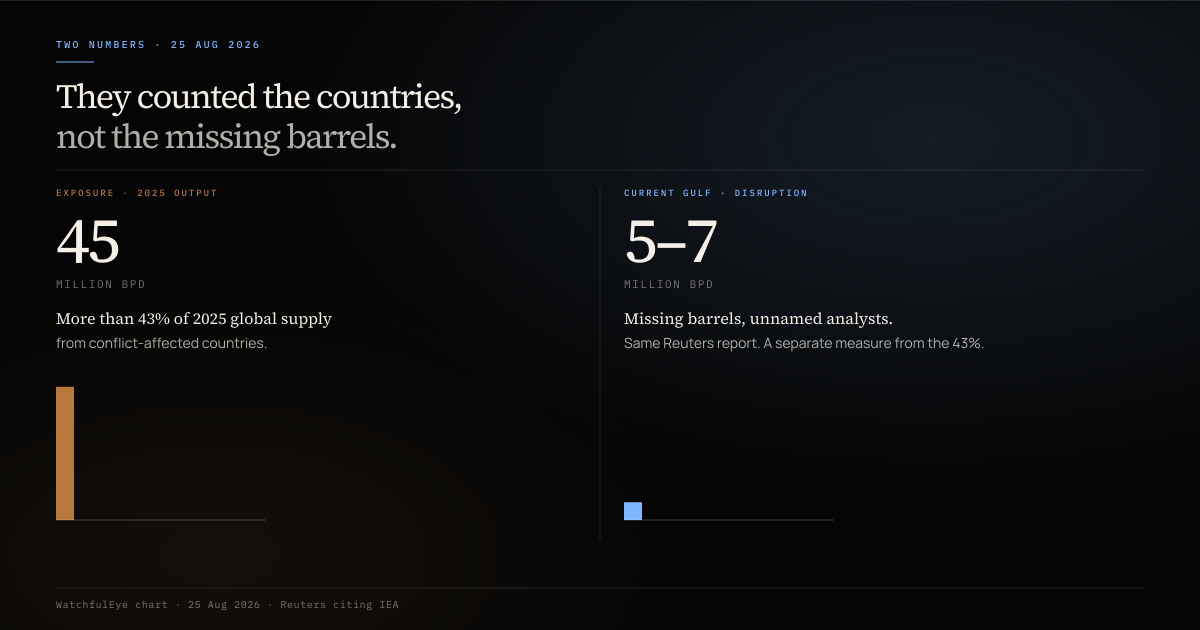
Reuters, 25 August 2026, citing the IEA. Exposure is not barrels offline. Not a satellite image.
## What changed
Reuters on 25 August, London byline Seher Dareen, Anushree Mukherjee and Robert Harvey, reports two numbers that measure different things.
Almost half the world's oil comes from countries affected by conflict in 2026, Reuters calculations show.
Six months ago, U.S. and Israeli attacks on Iran triggered what Reuters calls the largest oil supply crisis on record.
At the same time, the Russia-Ukraine war has forced production and refining cuts, including in nearby Kazakhstan this year. Ongoing conflict in Libya and U.S. restrictions on Venezuelan oil exports at the start of the year added further strain.
Together, countries affected by those conflicts produced about 45 million barrels per day of oil based on 2025 output, accounting for more than 43 percent of global supply, according to Reuters calculations using International Energy Agency data.
That 45 million / more than 43 percent is exposure. It is 2025 output from conflict-affected countries. It is not barrels currently offline.
Not all of this year's supply disruptions happened at the same time.
With Saudi Arabia re-routing oil to the Red Sea and Gulf exporters sneaking oil secretly out of the Strait of Hormuz, the current Gulf oil disruption stands at around 5 million to 7 million bpd, according to analysts' estimates. The analysts are unnamed.
Those two figures are in the same Reuters report. They are not interchangeable.
Risks to total flows remain high, as attacks in the Red Sea and near Egypt's Suez Canal in July demonstrated.
The conflicts in the Gulf and Ukraine have also cut global refining capacity by about a tenth. Ukraine has targeted much of Russia's refining network, striking plants as far away as Omsk, about 2,700 km (1,680 miles) from Ukrainian-held territory. Russia is grappling with fuel shortages and has banned gasoline and diesel exports.
Higher fuel prices have become a key driver of inflation, contributing to higher borrowing costs and helping to push U.S. debt to a record $40 trillion, as Reuters reports. U.S. diesel prices have climbed to record levels despite refiners running at peak capacity.
The IEA has released record volumes from emergency stockpiles. Those releases are now largely complete, even as global inventories continue to decline. The disruptions have increased the world's reliance on U.S. oil supplies, though that too has occasionally been disrupted by severe weather.
Separately, two unnamed U.S. officials told Axios on 19 August that the southern lane was moving about 10 million barrels a day. That is not in the Reuters report.
An AFP analysis of Kpler data, published on 25 August, put commodity-carrier transits at an average of 15 a day from 8 July to 22 August, against 95 in February. That is not in the Reuters report either.
Four public numbers measure different things. Reuters headline more than 43 percent (exposure). Same Reuters report: 5 to 7 million bpd current Gulf missing (analysts). Axios: about 10 million still moving (officials). AFP: 15 transits a day versus 95 in February (Kpler data).
## Sources
Reuters, London, 25 August 2026. Byline: Seher Dareen, Anushree Mukherjee and Robert Harvey. Editing by Mark Potter. IEA-based calc: 45 million barrels / more than 43 percent of 2025 output from conflict-affected countries. Unnamed analysts: 5 million to 7 million bpd current Gulf disruption.
Axios, 19 August 2026. Byline: Barak Ravid. Two unnamed U.S. officials: about 10 million barrels a day, roughly half the pre-war volume, moving out of the strait through a southern channel along the coast of Oman.
AFP, 25 August 2026, via France24. AFP analysis of data from maritime tracker Kpler: commodity-carrier transits averaged 15 a day from 8 July to 22 August, against a daily average of 95 in February.
## How it is being framed
Almost-half frame. Nearly half of global oil comes from countries affected by conflict. That is the headline. It is a 2025 production share, not a 2026 outage share.
Missing-barrels frame. 5 to 7 million bpd current Gulf disruption. That is the Reuters report's own lost-flow number, from unnamed analysts, with Saudi Red Sea re-routing and secret Hormuz exits.
Still-moving frame. About 10 million barrels still moving on the southern lane. That is two unnamed U.S. officials, via Axios. Not Reuters.
Hull-count frame. 15 transits versus 95. That is AFP's analysis of Kpler data. Not Reuters.
Refining frame. Capacity cut about a tenth. Russia export bans. U.S. diesel at record despite peak runs. IEA emergency releases largely complete; inventories still falling.
Those jobs are not the same story. The almost-half frame will keep traveling. Exposure and missing barrels are the ones that can be checked against each other.
## Reporting versus inference
Reporting is: Reuters published the 45 million / more than 43 percent figure as 2025 output from conflict-affected countries using IEA data; Reuters published 5 million to 7 million bpd as the current Gulf disruption according to unnamed analysts; Reuters listed Iran (six months after U.S. and Israeli attacks), Russia-Ukraine including Kazakhstan this year, Libya, and U.S. restrictions on Venezuelan exports at the start of the year as the conflicts in that calc; Reuters said not all disruptions happened at the same time; Reuters said refining capacity is down about a tenth; Reuters said Ukraine struck as far as Omsk, 2,700 km (1,680 miles); Reuters said Russia banned gasoline and diesel exports; Reuters said U.S. diesel is at record levels despite refiners at peak capacity; Reuters said IEA emergency releases are largely complete while inventories continue to decline; Reuters said U.S. debt is a record $40 trillion; the officials' about 10 million bpd claim was reported by Axios, not Reuters; the 15-versus-95 transit count is AFP's analysis of Kpler data, not Reuters.
Inference, labeled as such: "almost half" and "5 to 7 million barrels missing" cannot both be a description of barrels currently offline. The first is exposure. The second is a Gulf disruption estimate. Treating them as one number is the error. We do not have the IEA country table behind the 45 million. We do not have the analysts' names behind the 5 to 7. Reuters attributed 45 million / more than 43 percent to a calculation based on IEA figures for 2025 output, and 5 to 7 million to unnamed analysts in the same report.
## What may follow
Reasoning, not a forecast.
If the exposure frame is right, the test is whether a later IEA or Reuters report still uses 2025 output share as the "almost half" number, or publishes a 2026 lost-barrels number in the same unit. If the 5-to-7 frame is right, the next fact is whether an analyst or official estimate revises current Gulf disruption toward the officials' about 10 million still moving, or away from it. If the refining frame is right, the next fact is a refining-capacity or fuel-stock figure, not another country-share headline. If the IEA-release frame is right, the next inventory report shows whether the decline continues after releases that are largely complete.
## What remains unresolved
The country list behind the 45 million barrels. Whether Kazakhstan, Libya, and Venezuela barrels sit inside the 5-to-7 Gulf figure or only inside the 45. Whether 5-to-7 missing and about 10 million still moving can be the same waterway on the same day. A primary IEA table, not a Reuters calc. Names for the analysts. Whether the IEA emergency-release "largely complete" line is a stock number or a flow number.
## Corrections
If a source, a frame, or an inference on this page is wrong, we correct it here. contact@watchfuleye.us.
See how the story is framed, why it matters, and what happens next.