They said half. The tracker counted fifteen.
WatchfulEye ·
The conventional narrative is that the southern lane restored half the oil. Tuesday brought a tracker count and a leftover that is still inside the Gulf.
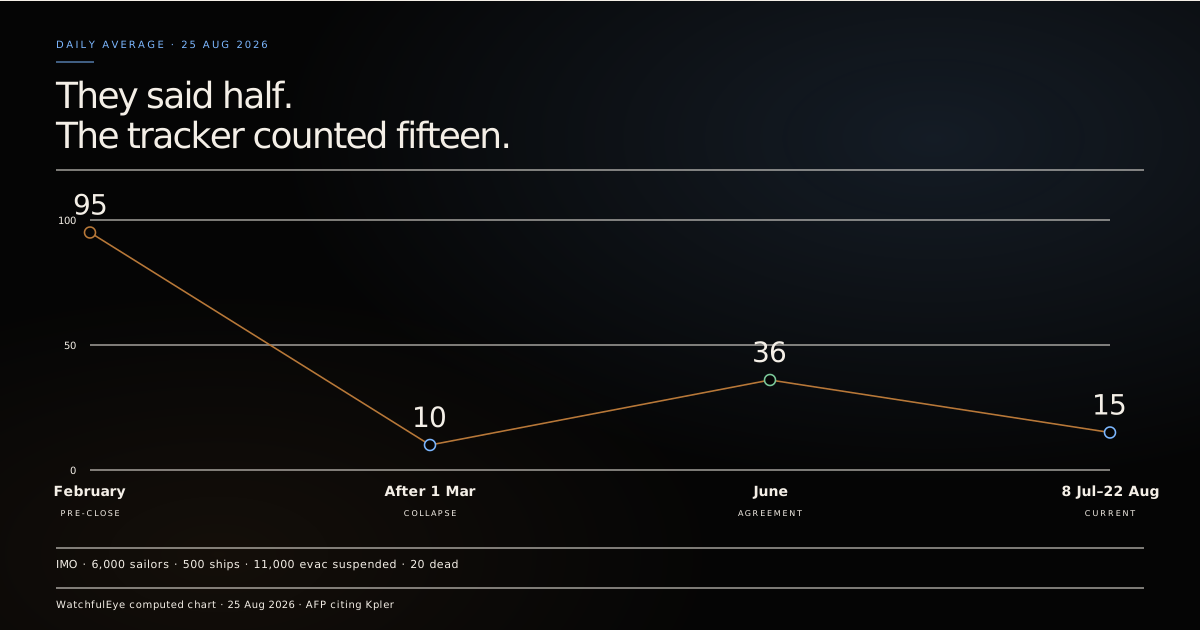
AFP, 25 August 2026, citing Kpler and the IMO. Commodity-carrier transits: February 95, after 1 March 10, June 36, 8 July to 22 August average 15. Not a satellite image.
## What changed
On 19 August, two unnamed U.S. officials told Axios the Oman-coast corridor was running 15 to 20 tankers a day, about 10 million barrels, roughly half of pre-war volume.
AFP on 25 August, analyzing Kpler data, reports a different series. Commodity-carrier transits through the Strait of Hormuz: 95 a day in February, before the closure. 10 a day after 1 March. 36 a day during the June agreement. Then 15 a day averaged between the resumption of hostilities on 8 July and 22 August.
Fifteen is not 15 to 20 and 10 million barrels. Fifteen against 95 is about a sixth, not half.
The same AFP report splits the lane. During the relatively calm window 17 June to 7 July: nine ships a day on the Iranian (northern) route, eight on the Omani (southern) route, the rest unidentified or on the old IMO corridor. Since 8 July, Kpler says two-thirds of transits have gone dark -- disabled transponders, jammed signals, or missing satellite imagery -- against less than one percent before the war.
The IMO told AFP some 6,000 sailors and 500 ships have remained stuck in the Gulf since the beginning of the conflict. A June effort to evacuate more than 11,000 seafarers was suspended after an attack on a vessel. Over six months, at least 20 sailors and dockworkers have been killed in incidents or attacks in the region, according to the IMO.
Barron's ran the same AFP headline on 25 August. France24 published the AFP report. The numbers that can be checked are in the AFP report, attributed to Kpler and the IMO.
## Sources
AFP, 25 August 2026, published by France24 and Barron's. Kpler commodity-carrier transits: 95 a day in February; 10 a day after 1 March; 36 a day during the June agreement; 15 a day averaged 8 July to 22 August. Route split 17 June to 7 July: nine north, eight south. Two-thirds dark since 8 July, against less than one percent before the war. Southern lane between the Omani coast and a 1,400-square-kilometre Guards "danger zone" where mines may be present, AFP says.
IMO, as told to AFP, 25 August 2026. Some 6,000 sailors and 500 ships still stuck in the Gulf. June evacuation of more than 11,000 seafarers suspended after an attack. At least 20 sailors and dockworkers killed over six months.
Axios, 19 August 2026. Two unnamed U.S. officials: 15 to 20 tankers a day, about 10 million barrels, roughly half of pre-war volume, Oman-coast corridor.
## How it is being framed
Half-restored frame. 15 to 20 hulls and 10 million barrels. That is the 19 August officials' claim, as reported by Axios.
Count frame. 95, then 10, then 36, then 15. That is AFP's analysis of Kpler data, through 22 August.
Dark frame. Two-thirds unknown since 8 July. That is a visibility claim, not a barrel claim.
Oman-versus-Iran frame. Nine north, eight south, in the calm window. Tehran's approved lane is the northern one. The southern one runs between the Omani coast and a 1,400-square-kilometre Guards "danger zone" where mines may be present, AFP says.
Stranded frame. 6,000 sailors, 500 ships, evacuation suspended, at least 20 dead. That is the IMO talking to AFP.
Those five jobs are not the same story. The half-restored frame will keep traveling. The series, the dark share, and the leftover inside the Gulf are the ones that can be checked.
## Reporting versus inference
Reporting is: AFP published a Kpler series on 25 August with those four period averages; AFP published a 9-versus-8 route split for 17 June to 7 July; AFP published two-thirds dark since 8 July; the IMO told AFP 6,000 sailors and 500 ships remain stuck, a more-than-11,000 evacuation was suspended after an attack, and at least 20 sailors and dockworkers have been killed; Barron's and France24 published that AFP report; the 19 August officials' 15 to 20 / about 10 million barrels a day claim was reported by Axios.
Inference, labeled as such: a "half restored" corridor and a 15-versus-95 tracker average cannot both be a description of the same visible waterway unless the officials were counting barrels the tracker was not, or counting a capacity the AIS cannot see because two-thirds of transits are dark. We do not have a primary Kpler table. We do not have the officials' voyage list. AFP attributed those figures to Kpler and the IMO. None of 15 hulls, 10 million barrels or 6,000 people is independently confirmed.
## What may follow
Reasoning, not a forecast.
If the count frame is right, the test is whether the post-22 August daily count stays near 15, or shows the officials' 15 to 20 as a barrel figure rather than a hull figure. If the dark frame is right, the next fact is whether the two-thirds share holds in a Kpler or UKMTO report, not in a six-month roundup. If the stranded frame is right, the next IMO figure revises 6,000 and 500, or names a restarted evacuation. If the Oman-versus-Iran frame is right, the next visible transits cluster south, north, or stay unknown. We do not have a 23-24 August daily table in the AFP report.
## What remains unresolved
Whether AFP's 95 February commodity carriers is the same Kpler cut as the about-130 pre-war figure CNBC reported from Kpler on 17 August. Whether 15 transits can be reconciled with 10 million barrels. Which of the dark transits are the Oman lane. Whether the 6,000 and 500 are still current as of 25 August, or a stock figure from earlier in the war. A primary Kpler table. An IMO document, not an IMO quote.
## Corrections
If a source, a frame, or an inference on this page is wrong, we correct it here. contact@watchfuleye.us.
See how the story is framed, why it matters, and what happens next.