Iran · Public record
UN investigators find reasonable grounds that US strikes on a Minab school and a Lamerd sports centre were war crimes, and that Iran committed crimes against humanity in its protest crackdown.
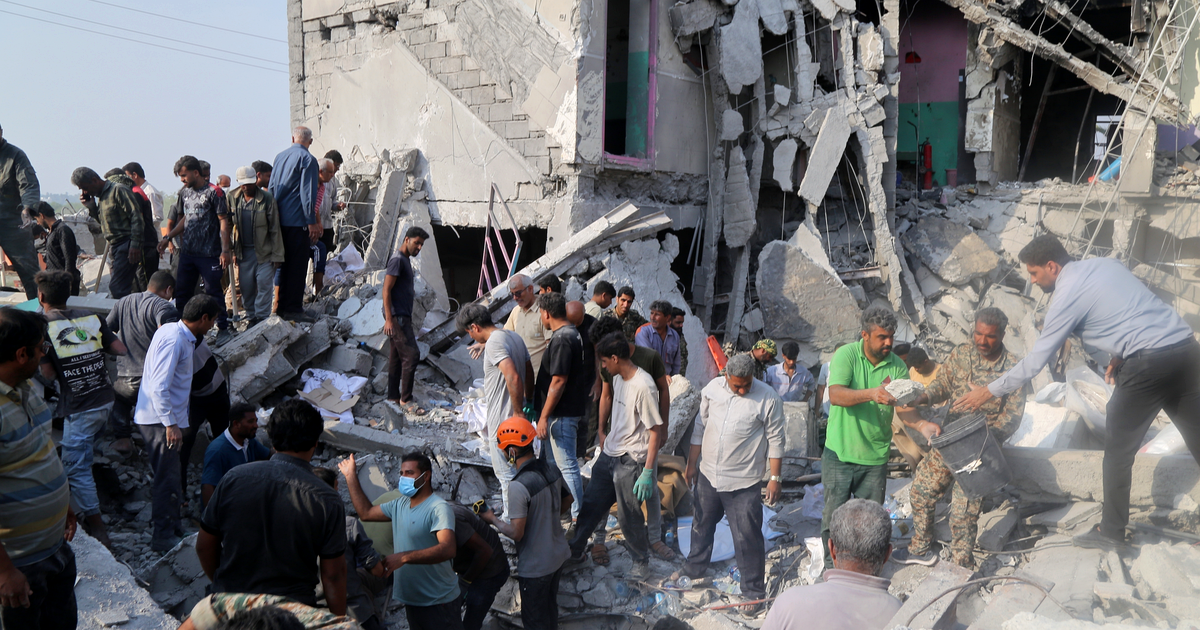
A UN-mandated investigation has put two sets of alleged crimes in one report. On Thursday 17 September 2026, the Independent International Fact-Finding Mission on the Islamic Republic of Iran said it had reasonable grounds to believe the United States committed war crimes in two strikes on 28 February, the first day of the US-Israeli war on Iran: Tomahawk missiles on the Shajareh Tayyebeh Primary School in Minab, and Precision Strike Missiles over a sports centre and residential streets in Lamerd. The same report found that Iran's government committed crimes against humanity in crushing the protests that began on 28 December 2025.
The mission's report to the UN Human Rights Council (document A/HRC/63/61) records 156 people killed at the Minab school, the final toll announced by the Minab prosecutor, including 120 schoolchildren and 26 educators, all of them women; "credible independent information" put the toll at 157, including 123 children. It records 22 people killed in Lamerd, according to the head of the county's sports and youth department. The UN human rights office's press release put the two strikes together at "at least 178 civilians", the sum of the report's 156 and 22.
Washington rejects the finding. White House spokeswoman Anna Kelly said, as quoted by Axios and Al Jazeera, that "the only party in this conflict that has committed war crimes is the Iranian regime." A State Department official said the United States does not give the findings credibility, CNBC and the BBC reported; CNBC quoted the official as saying the council "pushes anti-American rhetoric and antisemitism." The Pentagon told Axios its investigation remains ongoing. US Central Command has denied carrying out the Lamerd strike.
Why it matters
In May, Central Command's commander, Admiral Brad Cooper, told the House Armed Services Committee the Minab strike "correlated" with a US strike, Axios reported. On 17 June, asked at the G7 summit in France about the Minab school strike, President Donald Trump said it was under investigation, that mistakes are made in war and that "nobody did that on purpose," Reuters reported. The UN mission goes further. It concludes that the school was "the intended point of impact," not an errant missile or spillover from the Revolutionary Guard naval complex about 72 metres away, and that the US failure to update its targeting data "went beyond mere negligence." That is a reckless-conduct finding, not an accident finding, from a body whose requests the US has not answered. The mission says it wrote to Washington in June and got no reply.
The same document also removes the one-sided reading either government would prefer. Its authors say Iranian security forces killed protesters on "a staggering and unprecedented scale" in all 31 provinces, and that the killings, mass detention and torture amount to crimes against humanity. Each capital can cite the half that suits it. The report does not let either half stand alone.
What is reported
- UN Fact-Finding Mission on Iran, report A/HRC/63/61 (advance edited version dated 21 September) and OHCHR press release (17 September):
- Minab: the school, for girls and boys aged 6 to 13, was struck between about 10.30 and 11.30 a.m. on 28 February. Satellite imagery shows it in its own walled compound with its own street entrance; photographs show child murals, school signs and play areas. Survivors told Iranian media it was hit twice, the second time on the upper floor where staff had moved children. Weapons specialists identified a Tomahawk Land Attack Missile from remnants; the mission notes the US is the only party to the conflict with Tomahawks. The mission finds reasonable grounds that the strike was the war crime of making a civilian object the object of an attack.
- Lamerd: at about 5.10 p.m. the same day, missiles burst above the Shahid Haj Khalil Naimi cultural and sports complex and a neighbouring residential area, scattering tungsten pellets (the report cites roughly 180,000 per missile). Twenty-two people were killed, 10 women and 12 men per the county official, and local officials reported more than 100 injured. Central Command confirmed on 4 March that it had used Precision Strike Missiles in Iran for the first time; on 31 March it denied the Lamerd strike and said the munition looked more like an Iranian Hoveyzeh cruise missile, which weapons experts disputed. The mission finds reasonable grounds that Lamerd was the war crime of launching an indiscriminate attack.
- Iran: the government published an official list of 3,038 people killed in early February; the mission says it has "strong grounds" to believe the true toll is significantly higher. A rights group has named at least 221 children killed. At least 29 men have been executed since March in connection with the protests, in several cases after expedited trials. The mission finds crimes against humanity of murder, imprisonment, torture and other inhuman acts.
- BBC (17 September, David Gritten): at least 177 civilians killed across both strikes, using local-authority tolls of at least 156 at Minab and at least 21 at Lamerd. A State Department official said the US did not give credibility to the findings.
- Axios (17 September): the Pentagon declined to comment but said its investigation is ongoing; CENTCOM has denied the sports centre attack; the mission sought meetings with US officials and got no response.
- Al Jazeera (18 September, Heba Habib): Kelly's statement in full; human rights lawyer Reed Brody said the report "doesn't by itself generate any consequences" but can "form the basis for other proceedings."
- CNBC (18 September): the State Department official's "anti-American rhetoric" remark; the US left the Human Rights Council by executive order in February 2025.
Inference (not a finding)
The most plausible reading is that the Minab case now turns on a document the US has not released. The mission relied in part on press reports of a preliminary Pentagon inquiry and on Admiral Cooper's "correlated" remark; it states plainly that it had neither US answers nor the internal findings. If the Pentagon publishes its review, it will either confirm the outdated-target account the mission relied on or give Washington its first detailed rebuttal. Lamerd is the harder attribution fight, because Central Command still denies it. On the Iranian side, the finding adds to a record Tehran has already rejected; the report itself gives no sign that Iran will change course on executions.
Uncertainty
- "Reasonable grounds to believe" is the mission's standard of proof. It is not a court ruling. Reed Brody, a human rights lawyer quoted by Al Jazeera, said the report "doesn't by itself generate any consequences."
- Death tolls differ by source. The mission's report cites 156 (Minab prosecutor) and 157 (independent information) at Minab, and 22 at Lamerd. The BBC used 21 at Lamerd and a combined 177; the UN press release says at least 178. Accounts of how many children died at Lamerd also differ between outlets.
- The mission had no access to US personnel or records and relied on satellite imagery, verified video, weapons analysis and Iranian and independent witness accounts.
- The press release describes both strikes as indiscriminate attacks. The report's legal conclusions use that label for Lamerd only; for Minab they find the war crime of "making a civilian object the object of an attack". Coverage including the BBC, Axios and CNBC used the press release's wording for both strikes.
- Iran has previously rejected allegations of systematic human rights violations and blames the protest deaths on "terrorists" and "rioters," the BBC reported. The mission says it cannot yet determine the protest death toll to its standard of proof, because the government's lists give no breakdown by location, gender or age and do not match names collected by rights organisations.
What happens next
- Whether the Pentagon releases or summarises its Minab investigation, which the mission explicitly asks the US to disclose.
- Whether Central Command publishes evidence for its Hoveyzeh account of Lamerd.
- The Human Rights Council's current session, which runs to 9 October, and whether any state tables follow-up on either set of findings.
- Whether any government acts on the mission's call for universal-jurisdiction cases, and whether Iran spares the more than 70 people the mission says remain at imminent risk of being sentenced to death or executed over the protests.