At least 72 gold miners killed in an air strike near the Sudan-Egypt border, a rights group says; it blames Egypt, which has not commented
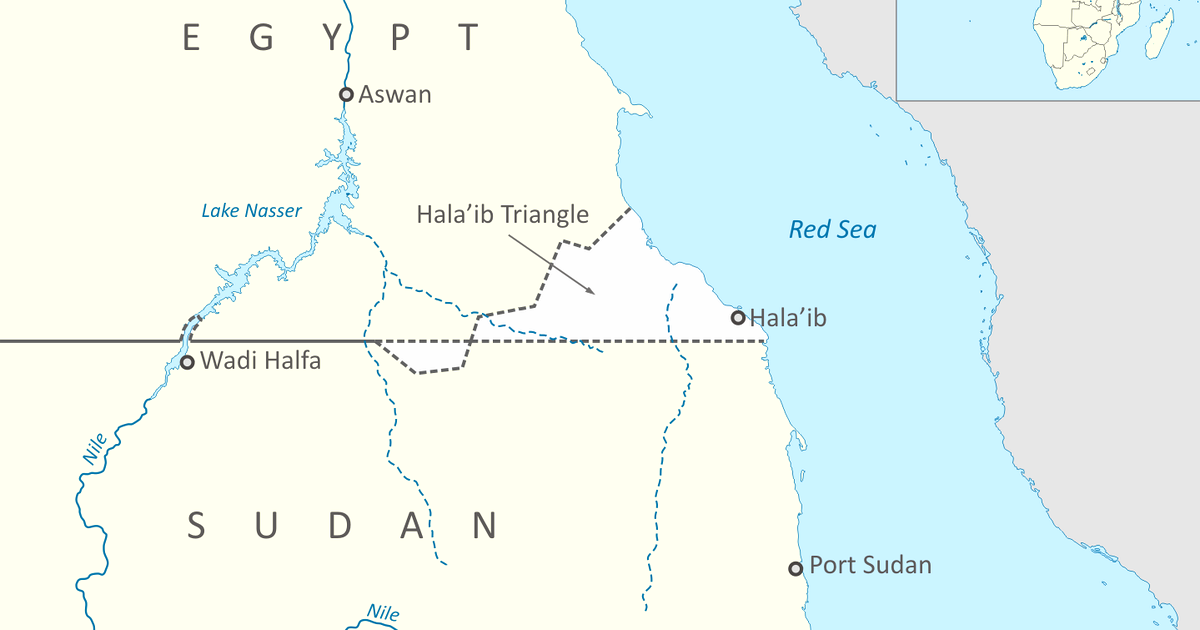
Map of the Egypt-Sudan border and the disputed Hala'ib Triangle (2010). The strike site is not marked: its exact location is disputed. Map: Пакко, derivative of maps by NordNordWest and Sting / CC BY-SA 3.0 (via Wikimedia Commons). Cropped.

At least 72 artisanal gold miners were killed in an air strike on Saturday 10 October in the mountains along the Sudan-Egypt border, the Sudanese rights group Emergency Lawyers said on Sunday, Reuters reported. The group called the figure preliminary and said "efforts to document and verify the casualty toll are ongoing," according to Middle East Eye.
Who says what
- Emergency Lawyers: the attack was "carried out by Egyptian military aircraft," the group said, and it maintains the attack occurred inside Sudanese territory, AFP reported. It said such a cross-border attack would violate international law, Reuters reported, and said: "The repeated attacks on the gold- and mineral-rich border regions reflect a desire by Egyptian authorities to expand and assert control over Sudan's natural resources," as quoted by DW.
- Egypt: the Egyptian military did not comment, and the foreign ministry did not immediately respond to Reuters. AFP said Egypt had issued no official comment, according to a copy of its report.
- Survivors: one survivor, Sharaf Ali, told AFP that thousands of people were working at the site when it was hit. "After the airstrike people scattered, some people came to Al-Ansary market, others went in the other direction, that's why no one knows how many exactly were killed," he said.
- Not verified: Reuters and AFP both said they could not independently verify the account. Reuters said images shared online, which it also could not verify, showed dozens of bodies.
Where it happened is part of the dispute
AFP named the site as Jabal al-Uqaydat, an informal gold mining area, and said this was the second deadly strike there this year. DW, citing AFP and AP, placed the attack south of the Halayeb Triangle, east of the Nile. Emergency Lawyers says the site is in Sudan. When strikes hit the same area in June, the Egyptian army said its operation took place "within Egyptian territory," AFP reported.
The Egyptian outlet Mada Masr reported in June that Jabal al-Uqaydat lies in Egypt, north of the Hala'ib Triangle. A miner told the outlet the mines sit about 50 km inside Egyptian territory, while mining activity runs from Sudan 50 to 70 km into Egypt. The Hala'ib Triangle itself, on the Red Sea coast, is claimed by both countries and has been run by Egypt since the mid-1990s, Mada Masr said.
The reports do not agree on which side of the Triangle the site lies, so the same strike can be described as an Egyptian operation against miners on its own soil or as a cross-border attack on Sudan. No independent source has yet placed the site on the map.
The June precedent
In June, strikes on mines in the same area killed 23 people, a Sudanese medical source told Mada Masr, well below the figures that first circulated on social media. Two senior Egyptian officials told the outlet that Egypt had carried out "airstrikes against Sudanese groups that crossed into Egyptian territory and are engaged in gold mining without obtaining the necessary licenses." The Egyptian army said it detained 223 people, including 136 foreign nationals, and announced a campaign against "illegal gold mining and arms smuggling," AFP reported.
Egyptian officials gave Mada Masr three motives: control of the gold fields, fear that the network of armed smugglers around informal mining could grow into more formidable armed groups, and a message that Egypt "will not relinquish its sovereignty over the Halayeb and Shalateen Triangle."
Why gold matters to Sudan's war
Gold has become the key source of cash for both sides in Sudan's war between the army and the paramilitary Rapid Support Forces, and people in the sector say much of it is smuggled into Egypt, Reuters reported. The UK think tank Chatham House estimates that as much as 60% of Sudan's unofficial gold exports end up in Egypt, DW reported.
Egypt is a key ally of Sudan's army chief, Abdel Fattah al-Burhan, AFP reported. If Egyptian aircraft did carry out Saturday's strike, a key ally of the army would have killed dozens of civilian miners on a contested border. WatchfulEye's read: that is why the location matters more than usual, and why Cairo's silence leaves the main question open.
What would settle it
- A statement from Egypt's military or foreign ministry.
- A response from Sudan's army-led government.
- Independent confirmation of the site's coordinates and the death toll, for example from satellite imagery or a UN body.
Context
WatchfulEye's other Sudan coverage includes RSF drone strikes on el-Obeid's power and water in Kordofan and the US call for stronger UN sanctions on both warring sides.
Seventy-two dead is a rights group's preliminary count, and Egypt's role is an accusation until Cairo or an independent source speaks. The open questions are who flew the aircraft and which side of the border they struck.