Eurasia · Public record
A Russian drone hit Ukraine's National Academy of Sciences in central Kyiv, killing two people.
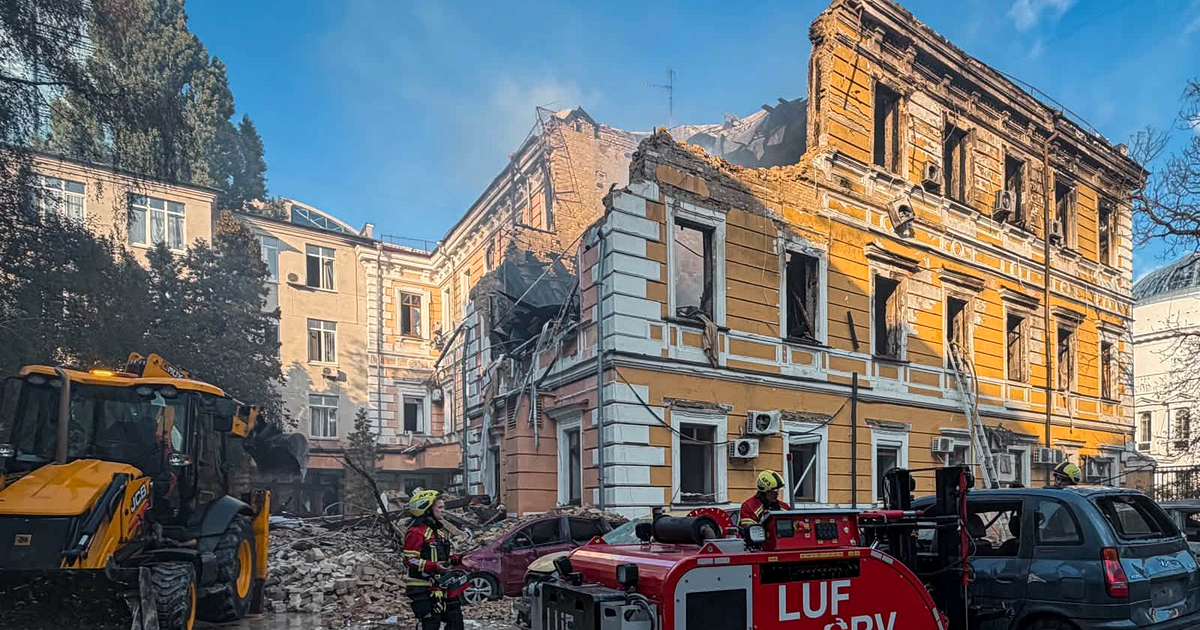
A Russian drone struck the National Academy of Sciences of Ukraine in central Kyiv on Monday 28 September 2026, killing two people, Reuters reported, citing emergency services. One of the dead was recovered from under the rubble later that evening. The 19th-century building stands near the German embassy, the National Opera and St Volodymyr's Cathedral, the Guardian reported.
Flames spread through the building while staff were inside. Two survivors climbed from upper-storey windows onto ladders raised by rescuers, Reuters said. "We are not connected with the military. This is an attack on science. It is terrorism," Anatoliy Zagorodny, the academy's president, told the Guardian outside the burning building.
Volodymyr Horbulin, the academy's first vice-president and a former secretary of Ukraine's National Security and Defence Council, was slightly wounded. He told the public broadcaster Suspilne that his assistant, who was near the building, was killed, Al Jazeera reported.
Why it matters
The strike came in daylight, on a working day, in the historic centre of the capital. The Guardian said the attack is likely to raise fresh concerns over Ukraine's ability to protect even the most heavily guarded parts of Kyiv. Russia has begun hitting Kyiv and other cities with faster, high-flying jet-powered drones, Reuters reported. President Volodymyr Zelenskyy said 90 of the 120 drones fired at Ukraine on Monday were jet-powered, and that Ukraine intercepted 57% of that type. "New interceptors are being actively tested," he said in his nightly address, according to Reuters.
The academy is a civilian research body, but it has long-standing ties to Ukraine's defence sector, the Guardian said. Foreign Minister Andrii Sybiha accused Russia of cynicism for targeting a scientific institution during the working day. "Russia is deliberately expanding the boundaries of what it believes the world will tolerate," he said, and called on allies for more air defences, Reuters reported.
What is reported
- Reuters (Kyiv, 28 September):
- Zelenskyy said nine people were killed and more than 80 injured in Russian drone strikes across Ukraine on Monday.
- Kyiv Mayor Vitali Klitschko said 24 people were injured in several attacks on the capital, six of them in hospital.
- Officials reported strikes on a pharmaceutical company, petrol stations and a medical facility in Kyiv.
- A drone attack on a business centre in Dnipro killed three people. Prime Minister Sergii Koretskyi said 19 were injured there.
- Zelenskyy said Ukraine struck Russian oil facilities in the Krasnodar region and two defence plants on Monday.
- The Guardian (Pjotr Sauer, 28 September; updated 29 September):
- Another Russian drone struck a nearby private medical centre, killing at least one person.
- Moscow has shifted more attacks into daylight hours, and many Ukrainians keep working through drone alerts.
- Kremlin spokesperson Dmitry Peskov said on Monday that Ukraine "will have to pay a price" for its strikes deep inside Russia. "That is happening right now," he said.
- Al Jazeera (29 September):
- Explosions were heard across Kyiv early on Tuesday. Klitschko said missile debris fell in the courtyard of one building and another building caught fire.
- The academy called the attack "Russian terror" and "barbarity" aimed at "peaceful people who were simply at their workplaces".
- Correspondent Jonah Hull said Russia had been hitting economic targets for six days, including data centres and the mobile operators Kyivstar and Vodafone Ukraine.
What we don't know
- Why the academy was hit. Reuters, the Guardian and Al Jazeera carry no Russian comment on the academy strike itself. Zagorodny said he did not know why it was targeted.
- The full toll. Klitschko first said at least one person was killed at the academy, the Guardian reported. Emergency services later put the toll there at two. The nationwide figure of nine comes from Zelenskyy.
- The damage to collections and research. No inventory of losses inside the building has been published.
Inference (not a finding)
A daytime hit on a landmark civilian institution near an embassy and government buildings suggests that Russia's jet-powered drones are getting through defences built around the city centre. The 57% interception rate Zelenskyy gave for these drones, against faster targets, points to more strikes like this until new interceptors are working at scale.
What happens next
- Interceptors: Zelenskyy said new interceptors for jet-powered drones are being tested and some units are already using them.
- Allied air defence: Sybiha asked allies for more air defences after the strike.