Europe · Public record
They said forty-four percent. The firewall is the story.
The conventional narrative is another German state election. Saturday's public record is a forty-four percent AfD share and a firewall under load.
What changed
On 6 September 2026, Alternative for Germany won a reported 44 percent in Saxony-Anhalt’s state election — a record result in published reporting. Axios focused on the firewall the same night. Reuters, CNN, and other outlets reported the breakthrough the same day and left the governing outcome unresolved: a smaller party’s seats may decide whether AfD can form Germany’s first far-right state executive since World War II.
Sources
Axios, 6 September 2026: AfD at a record 44 percent in Saxony-Anhalt; firewall and coalition arithmetic as the immediate test. Corroboration on the share and the unresolved executive path: Reuters, CNN, and related European same-day reporting. The governing outcome is not settled in that reporting — smaller-party seats and whether established parties keep their postwar refusal to cooperate with AfD remain open.
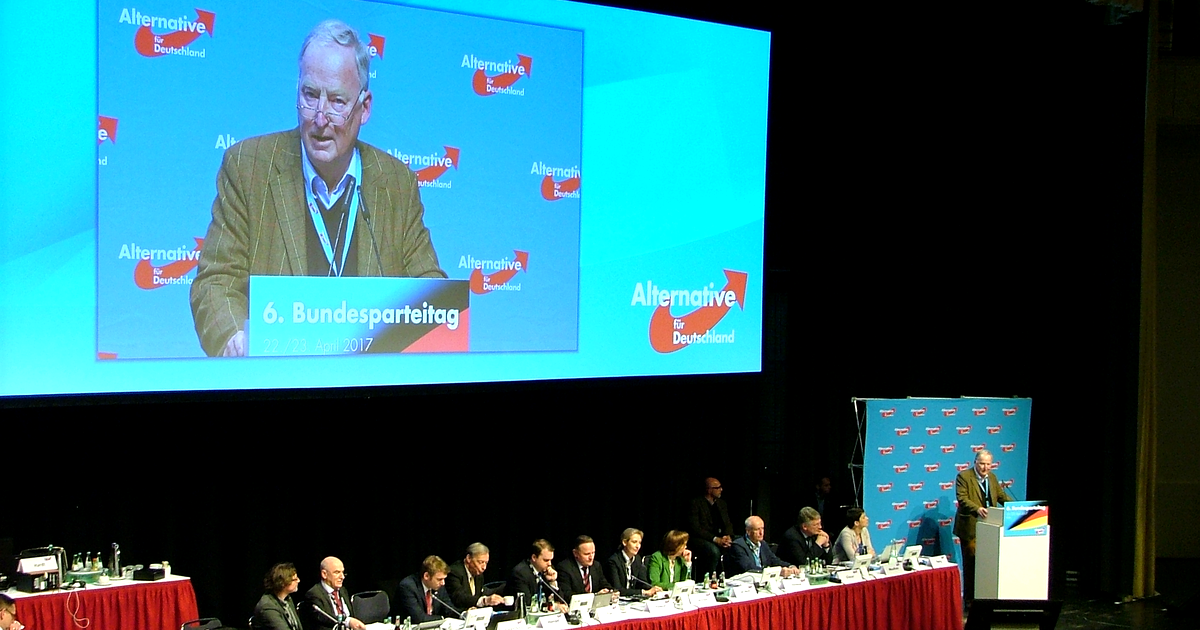
Photograph: AfD 6. Bundesparteitag congress hall in Köln (Olaf Kosinsky, 23 April 2017, CC BY-SA 3.0 DE).
How it is being framed
The result is a record. Forty-four percent in a Landtag vote is the new number.
The firewall is under test. It is the postwar refusal to cooperate with AfD: will established parties keep it when a smaller party’s seats decide the executive?
A precedent is possible. The first far-right state government since World War II is still a possibility, not a formed cabinet in the reporting so far.
AfD can set the agenda without office. It shapes the state agenda even if excluded from the executive, which is separate from entering government.
Those are not the same story. The 44 percent can be checked.
Reporting versus inference
Reporting is: AfD won a reported 44 percent in Saxony-Anhalt on 6 September 2026; Axios, Reuters, and CNN reported that record share and left coalition formation unresolved; a smaller party’s seats may decide whether AfD reaches state executive power; Germany’s established parties’ postwar refusal to cooperate with AfD is the immediate institutional test named in that reporting.
Inference, labeled as such: a record Landtag share is not yet a formed government, a broken federal firewall, or a market event. Forty-four percent is not every Land. The share and the unresolved executive path are confirmed in published reporting.
What may follow
Reasoning, not a forecast.
If the firewall is the story, the next checkable fact is a smaller party publicly ruling out AfD cooperation — or opening talks — within a short window. If a precedent is coming, Saxony-Anhalt’s established parties announce a governing arrangement that excludes AfD, or they fail to. If AfD's power lies in the agenda rather than office, AfD shapes the Landtag calendar without ministers. If national party leaderships change firewall language or migration positions after this result, that is a separate federal story.
What remains unresolved
Whether AfD enters the Saxony-Anhalt executive. Which smaller party has the pivotal seats, and what it says next. Whether national CDU/SPD/Greens/FDP language on the firewall moves. Market effects remain conditional and indirect.
Related
Corrections
If a source or an inference on this page is wrong, we correct it here. contact@watchfuleye.us.
See how the story is framed, why it matters, and what happens next.